.svg)


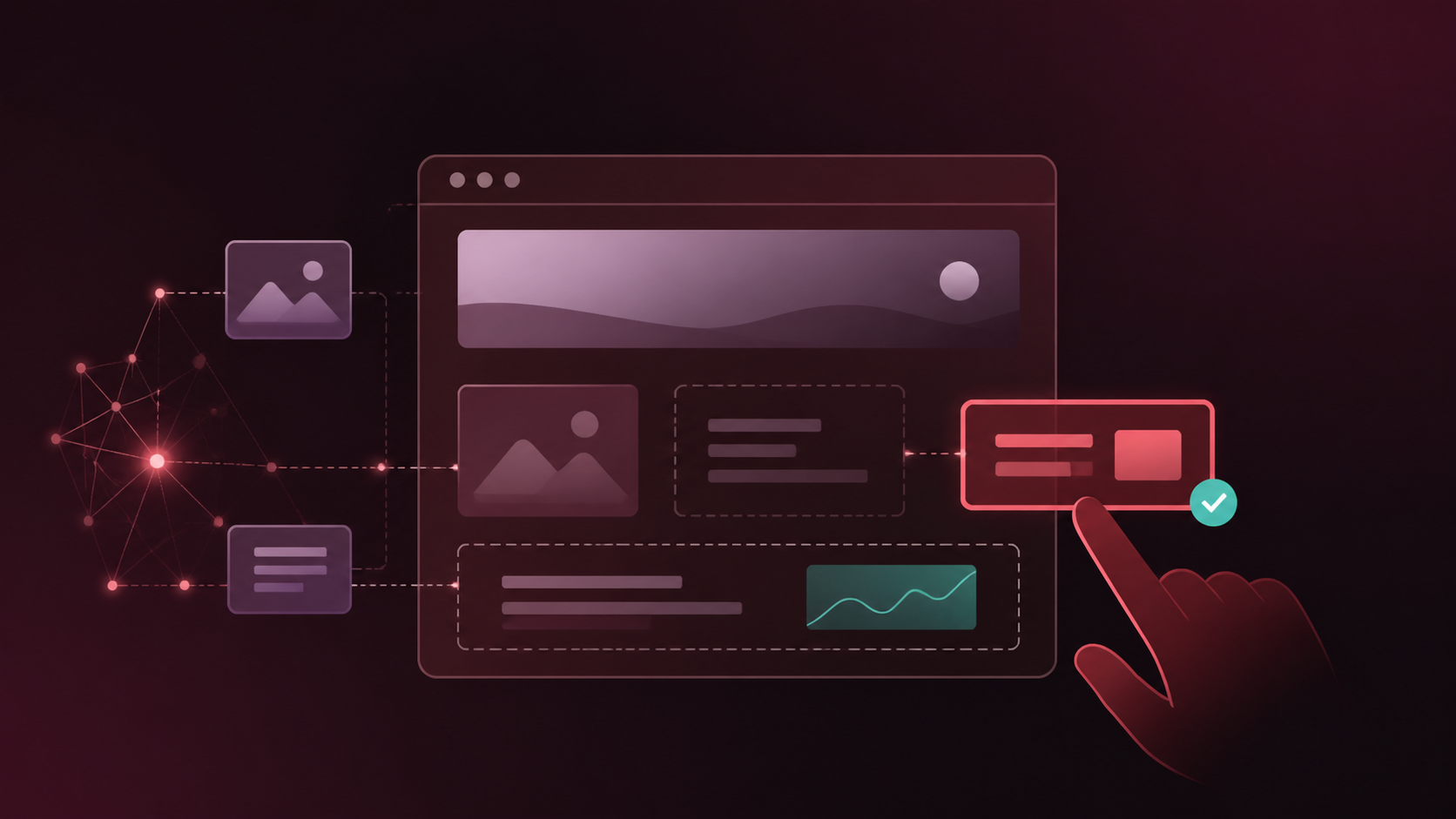
Yes, AI can help build a website, software product or digital platform.
It can accelerate research, prototyping, coding, testing and documentation. It can help turn an idea into something people can see and use much faster.
But AI does not remove the need for clear commercial objectives, user research, technical architecture, accessibility, security or responsible data use.
My view is simple: use AI to move faster, but keep people accountable for what gets built.
In brief
AI can help with: research, prototyping, coding and testing.
AI cannot replace: strategy, security, accessibility or accountable human decisions.
What to do next: choose one problem, one user group and the smallest useful test.
What does building a website or platform with AI mean?
“Built with AI” can mean several different things.
AI-assisted development
This is where designers, developers and content teams use AI to support their work.
AI might help generate code, create test cases, organise research, draft content or document how a system works. The delivery team still decides what should be built and checks the output.
AI features within a platform
The platform itself might use AI to:
- search a library of documents;
- summarise customer enquiries;
- recommend products or resources;
- classify information;
- help staff draft responses; or
- identify patterns in operational data.
Here, AI is one component within a wider digital platform.
AI-generated prototypes
New tools can turn a written description into a working application without requiring the user to write much code directly.
This is useful for testing an idea. It becomes risky when a convincing prototype is mistaken for a secure, reliable and production-ready platform.
Where can AI improve website and platform development?
AI is most useful when it accelerates work without removing human oversight.
Turning an idea into a prototype
AI can help produce page layouts, customer journeys, database structures, forms and early integrations.
This makes it easier to test an idea with real users before investing in a complete build.
Instead of asking people to imagine how something might work, you can show them and see what they actually do.
Supporting developers
AI can help experienced developers with repetitive code, troubleshooting, documentation and testing.
That leaves more time for the parts that require proper judgement: architecture, security, integrations, performance and user experience.
AI proposes. The development team verifies and remains accountable.
Organising content and information
AI can help structure website content, create initial metadata, identify inconsistencies and prepare draft guidance for users and administrators.
That can save time, but the content still needs to be checked for accuracy, relevance and brand voice.
Producing more content is not the objective. Producing something useful is.
Testing assumptions earlier
This is one of the strongest reasons to use AI.
A focused prototype can help answer questions before too much money is committed:
- Do people understand the idea?
- Can they complete the important task?
- Does the proposed workflow solve the real problem?
- Is there enough value to justify a full build?
AI can make these tests easier and quicker to run.
What can’t AI replace?
The most important parts of a digital project normally happen before and around the code.
A clear outcome
A platform needs to solve a worthwhile problem.
You may want to increase enquiries, reduce administration, improve customer retention, provide a better member service or replace several disconnected systems.
If the intended outcome is unclear, AI can simply help you build the wrong thing faster.
Understanding your users
AI does not know your customers, staff or service users.
It does not automatically know why someone abandons a form, what creates trust or which part of an internal process causes the most frustration.
That evidence comes from customer conversations, analytics, observation and testing.
Technical architecture
A generated application may look impressive while being difficult to maintain or integrate with your other systems.
Someone still needs to decide:
- where information is stored;
- how systems communicate;
- who can access what;
- what happens when an integration fails;
- which actions AI is allowed to take; and
- who maintains the platform after launch.
These decisions determine whether the platform remains useful after the initial demonstration.
Security and data protection
AI creates additional risks when a platform handles personal, financial, health or commercially sensitive information.
The Information Commissioner’s Office guidance makes it clear that organisations using AI must consider fairness, transparency, data minimisation, accuracy, security and accountability.
You need to understand:
- what information the AI can access;
- why that information is needed;
- where it is sent or stored;
- who can see the output;
- how errors will be identified; and
- how people can challenge or correct a decision.
The OWASP guidance for generative AI applications also identifies risks including prompt injection, sensitive information disclosure, supply-chain weaknesses and giving AI systems too much authority.
Security cannot be solved by adding another instruction to a prompt.
Accessibility and quality assurance
A platform does not just need to look complete. It must work for people using different devices, browsers and assistive technologies.
AI-generated code can appear convincing while containing errors, insecure assumptions or unnecessary dependencies.
The finished platform still needs structured testing across functionality, security, accessibility, performance, integrations and data handling.
What is the difference between an AI prototype and a finished platform?
A prototype answers one useful question:
Could this idea work?
A production platform needs to answer several more:
- Can people use it successfully?
- Is the information accurate?
- Is personal data protected?
- Can it cope with increased usage?
- What happens when something goes wrong?
- Can another developer maintain it?
- Does it integrate properly with existing systems?
- Who is responsible for monitoring it?
- Does it produce the intended commercial or service result?
AI makes it easier to create a prototype. It does not make these questions disappear.
Does every new platform need AI?
No.
Sometimes a clear website, a well-designed form or a straightforward automation will solve the problem more reliably and at a lower ongoing cost.
AI is useful when it can interpret, summarise, classify or generate information in a way that genuinely improves the service.
It is less useful when the process can be handled through clear rules, better content or conventional software.
Starting with the technology is usually the wrong approach. Start with the problem.
Considering an AI-enabled platform? Book a 30-minute feasibility call.
What should you decide before building with AI?
Before investing in an AI-enabled website or platform, answer five questions.
1. What is the problem worth solving?
Be specific about the customer, operational or commercial problem.
“Using AI” is not an objective.
2. Does AI have a useful role?
Identify what AI would do better or more efficiently than a conventional workflow.
If that cannot be explained clearly, it may not be needed.
3. What information will it use?
Understand whether the platform will access personal, confidential or commercially sensitive information.
Only provide the information required for the defined purpose.
4. What happens when it is wrong?
Decide where human review is necessary, how users report problems and whether the system can take important actions automatically.
AI output should always be treated as fallible.
5. What is the smallest sensible next step?
Do not begin by commissioning the entire platform.
Choose one user group, one important workflow and one result that can be observed. Build enough to test the assumption and decide whether further investment is justified.
A practical checklist
Before moving from an idea to development, confirm:
- the problem being solved;
- who experiences that problem;
- what should improve;
- which parts genuinely benefit from AI;
- what information the system will process;
- the security, privacy and accessibility requirements;
- which existing systems it must connect to;
- where human review remains necessary;
- how it will be tested with real users;
- who will own and maintain it; and
- how success will be measured.
If several answers remain unclear, more code is unlikely to be the right next step.
Should you use AI to build your next platform?
AI is changing how websites, software and digital platforms are developed.
Used properly, it can help teams test ideas earlier, reduce repetitive work and concentrate their time on the decisions that matter.
But faster development is only useful when you are moving towards the right outcome.
At Cross Digital, we start with three questions:
What is the problem worth solving?
Does AI have a useful role?
What is the smallest sensible next step?
If you are considering a website, software product or AI-enabled platform, we can help you test the opportunity and decide what is worth building.
Book a call with Cross Digital.
Frequently asked questions
Can AI build an entire website?
AI can generate layouts, content and code for a website. A professional team should still check the strategy, user experience, accessibility, security, integrations and performance before it is published.
Can AI build a software platform?
AI can accelerate prototyping and development, but a production platform still needs sound architecture, testing, data protection and ongoing maintenance.
Is an AI-generated website secure?
Not automatically. AI-generated code can contain vulnerabilities or unsafe assumptions. It should be reviewed and tested before handling customer or business information.
Is AI website development cheaper?
AI can reduce time spent on some development tasks. The overall cost still depends on the complexity of the platform, integrations, data requirements, testing and ongoing support.
Should every business add AI to its website?
No. AI should only be used where it improves the customer experience, reduces useful work or solves a defined problem. A simpler solution may be more reliable and cost-effective.


.png)




.svg)